
Amazon Essentials
Amazon Essentials Cotton Knit Sleep Shorts 2-Pack, 7 Inch
A stated 7-inch length, cotton knit construction, drawstring and elastic waistband make this one of the clearer title-level specifications.
Check on AmazonThe details / Sleepwear guidance
Use a pair you know as the reference; a height chart cannot choose your preferred hem.
An inch measurement is easy to compare and surprisingly easy to overinterpret. A 7-inch inseam tells you the length along an inside seam. It does not tell you whether the hem will reach your knee, whether you will like it on a sofa, or how a lower crotch changes where that length begins.
The most useful starting point is a pair whose hem position you already understand. Compare candidate lengths against that reference, then consider the rise and opening that can change the on-body result.
As an Amazon Associate I earn from qualifying purchases.
A stated 7-inch length, cotton knit construction, drawstring and elastic waistband make this one of the clearer title-level specifications.
Check on Amazon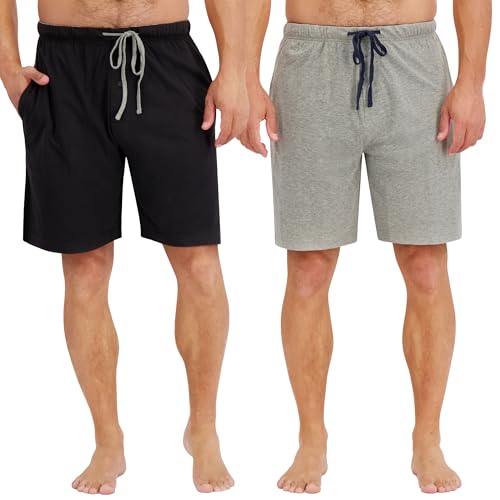
The listed 7.5-inch inseam makes these easier to compare for coverage than shorts described only as loose or lightweight.
Check on Amazon
The Supersoft name and 3.25-inch measurement distinguish this bundle from the standard Hanes Originals Comfywear listing.
Check on AmazonChoose a pair of shorts you have worn enough to describe clearly. It does not have to be perfect. In fact, a pair that feels too short when seated can be a useful reference if you can identify exactly what you want changed.
Put it on at its normal waistband position. Notice the standing hem at the front, side and inner leg, then sit in a familiar chair. Decide whether you want the next pair to finish higher, lower or about the same. This turns a numerical search into a comparison with something tangible.
Use the reference pair’s measured inseam rather than relying on an old listing title if the garment is already in your drawer. If you need the measurement method, use our flat-measurement guide. Here, the task is choosing what length to seek once that reference is known.
The Lands’ End inseam instructions also use a well-fitting garment of similar material as a reference. That supports starting with a real pair; it does not establish one preferred sleep-short length for every person.
A 3-inch and a 9-inch inseam differ substantially in inside-leg length. A 7-inch and a 7.5-inch inseam differ by only half an inch. Those comparisons are exact arithmetic, but the categories short, mid-thigh and knee-length remain descriptions whose on-body meaning depends on the wearer and pattern.
Do not assume a listed number applies identically to every size unless the seller says so. Some listings name a style length without explaining whether it is a sample-size measurement. The useful missing question is whether the candidate size has the stated inseam.
Fractions deserve the same attention as whole numbers. A 3.25-inch style and a 3.5-inch style differ by a quarter inch on paper, a smaller distinction than many shoppers imagine from their separate names. A different rise or curved hem could matter more to the overall look and coverage than that small inseam difference.
Likewise, a long-short label without a number is not useless, but it is less exact. It can narrow the kind of garment you want while you seek a size-specific measurement or compare the actual hem position.
| Candidate inseam | Difference from a 6-inch reference | Useful question |
|---|---|---|
| 3 inches | 3 inches less inside-seam length | Do I want a substantially higher inner-leg hem? |
| 5 inches | 1 inch less | Would a modestly shorter leg meet my preference? |
| 7 inches | 1 inch more | Am I seeking a small increase in leg length? |
| 7.5 inches | 1.5 inches more | Does the candidate’s rise resemble my reference? |
| 9 inches | 3 inches more | Will the hem approach a knee area I want clear? |
The table is an illustrative comparison, not a recommendation to buy any of these lengths. You can substitute your own reference and subtract it from each candidate. Keep the result labeled as an inseam difference rather than a promised body-position change.
The inseam begins at the crotch junction. If that junction sits lower in one garment, an equal inside-seam length can begin from a lower point on the body. Waistband placement and the front-and-back shape therefore influence where the hem ultimately lands.
This is one reason two pairs labeled 5 inches can look different when worn. You do not need to calculate a formula from rise to hem position; the garment’s shape is more complex than adding two numbers. Compare the candidates’ proportions and try them at their intended waistband positions.
Do not pull a high-rise short lower just to obtain a longer-looking leg. It may then have excess fabric or sit at a position its band does not naturally hold. Likewise, pulling a lower-rise short unusually high can change its whole fit while you are supposedly evaluating length.
If waistband placement is the main uncertainty, the rise comparison is the appropriate next read. Preserve that decision rather than asking inseam alone to solve it.
These two product titles show why the measurement label matters: Amazon Essentials’ listed 7-inch sleep shorts and Hanes’ listed 7.5-inch pajama shorts. Hanes explicitly states an inseam; the Amazon Essentials title gives a 7-inch designation without establishing what that measurement describes. Confirm the Amazon Essentials inseam for your selected size before calculating a length difference. Until then, use the Hanes measurement against your own reference pair.
You can inspect the exact Hanes 7.5-inch listing and compare more options in longer sleep shorts. For a much shorter reference, the catalog also contains Hanes women’s Originals Supersoft sleep shorts with 3.25-inch wording. That number belongs to the retrieved title and should be confirmed for your selected size.
The most useful shortlist contains lengths that test a real preference. If you want only slightly more coverage, comparing nearby inseams can make sense. If your current pair is far shorter than desired, several near-identical short options will not answer the question.
Imagine a wearer whose current 7-inch shorts sit above the knee when standing and move higher than desired on a low sofa. They consider a 9-inch pair. The extra 2 inches of inside-seam length is relevant, but the wearer also dislikes fabric collecting at the knee bend.
They first try a longer garment with a similar waistband position and reasonably similar leg shape. Standing, the coverage looks right. Seated, the hem lands in the knee fold and feels distracting. The longer number addressed one preference while conflicting with another.
A useful next comparison might be an intermediate length or a different opening shape, depending on what the seated check revealed. It would be unhelpful to declare that 9-inch shorts are wrong for everyone or that the wearer’s height requires 7 inches.
Now consider another person using the same reference lengths who values more coverage and does not mind the knee contact. The 9-inch option may meet their brief. Identical arithmetic can lead to different choices because the desired body position is personal.
Inseam describes the inside leg, while a curved hem may rise noticeably at the side. If you want coverage across the outer thigh, inspect that shortest side point too. A single number cannot describe the entire outline of a dolphin or split hem.
A straight hem can also tilt visually because of how the garment sits on the body. Rather than judging the whole short from the center-front photograph, look at side and seated views. You are choosing an outline in use, not just a measurement in isolation.
Do not turn this into a hunt for a mathematically perfect hem. Decide which area matters: inner leg, side thigh or knee clearance. Then give the matching view or measurement priority. Detailed opening-shape questions belong to leg-opening fit.
People of the same height can have different leg lengths, preferred waistband positions and coverage preferences. A rule that assigns one inseam to everyone above or below a height cannot capture those differences.
A model’s height and size can provide context for a photo, but you still do not know every proportion that affects the hem. Use that image to understand the garment’s intended appearance, then compare it with your reference pair.
If you are choosing between two lengths without trying them, favor the comparison with the clearest shared conditions: similar rise, similar cut and a stated inseam for the relevant size. If those conditions differ, recognize which part remains uncertain rather than adding false precision.
A successful choice is one whose hem meets your preference after you sit and move. The number helps you get there; it does not replace that preference.
No. Hem position depends on body proportions, crotch position, rise and the specific cut. Compare it with a pair you know rather than converting the number to a universal body landmark.
Their stated inseams differ by 2 inches. That is an inside-seam difference. The on-body hem may not move by exactly 2 inches if the rise, crotch position or cut also changes.
Use height only as context. A familiar pair’s inseam and actual hem position are more directly useful because people of the same height can have different proportions and coverage preferences.
Start with a known hem position, compare actual inseams and keep rise and hem shape in view. Choose the length that gives the coverage you want when seated as well as standing, without relying on height-only rules.
As an Amazon Associate I earn from qualifying purchases.
A stated 7-inch length, cotton knit construction, drawstring and elastic waistband make this one of the clearer title-level specifications.
Check on AmazonThe listed 7.5-inch inseam makes these easier to compare for coverage than shorts described only as loose or lightweight.
Check on AmazonThe Supersoft name and 3.25-inch measurement distinguish this bundle from the standard Hanes Originals Comfywear listing.
Check on AmazonThe details
A consistent measurement method is more useful than a very precise number taken from an unclear starting point.
The details
Choose where you want the band to sit, then see whether the whole garment supports that position.
The details
A long inseam and a roomy opening solve different problems.
The details
Hanes names its inseam explicitly; Amazon Essentials’ 7-inch title needs a measurement and size check before a half-inch comparison.
The details
A concise comparison of two Latuza Bermuda offers, with the known purchase differences kept separate from unresolved specifications.
The details
Choose how much leg you want covered, then check what the extra fabric does when you move.
The details
Before finding your row, find out what the chart is actually measuring.
The details
Watch where the fabric starts moving before choosing a longer leg or another size.
The details
Keep shorts if you like them; add coverage where you want it.